|
Explore
responses to this RRMM therapy
See
clinical trial results for this treatment option
|
|
| |
|
|
|
|
| |
|
INDICATION
|
|
BLENREP is indicated for the treatment of adults
with relapsed or refractory multiple myeloma who
have received at least 4 prior therapies,
including an anti-CD38 monoclonal antibody,
a proteasome inhibitor, and an
immunomodulatory agent. |
|
This indication is approved under accelerated
approval based on response rate. Continued
approval for this indication may be contingent
upon verification and description of clinical
benefit in a confirmatory trial(s).
| | | |
|
| IMPORTANT
SAFETY INFORMATION
|
| WARNING: OCULAR TOXICITY
|
| BLENREP caused changes in the
corneal epithelium resulting in changes in
vision, including severe vision loss and corneal
ulcer, and symptoms such as blurred vision and
dry eyes. |
| Conduct ophthalmic exams at
baseline, prior to each dose, and promptly for
worsening symptoms. Withhold BLENREP until
improvement and resume, or permanently
discontinue, based on severity. |
| Because of the risk of ocular
toxicity, BLENREP is available only through a
restricted program under a Risk Evaluation and
Mitigation Strategy (REMS) called the BLENREP
REMS.
| | |
| Continued
below.
| | | | | |
| |
|
|
| |
|
Dear Healthcare Professional, |
| In
recent years, advances have been made in the
management of multiple myeloma with the
introduction of novel therapies such as
immunomodulators, proteasome inhibitors, and
anti-CD38 monoclonal antibodies. However, many
patients may progress to relapsed and refractory
disease. BLENREP may be an option for appropriate
patients with relapsed or refractory multiple
myeloma who have received at least 4 prior
therapies.1,2 |
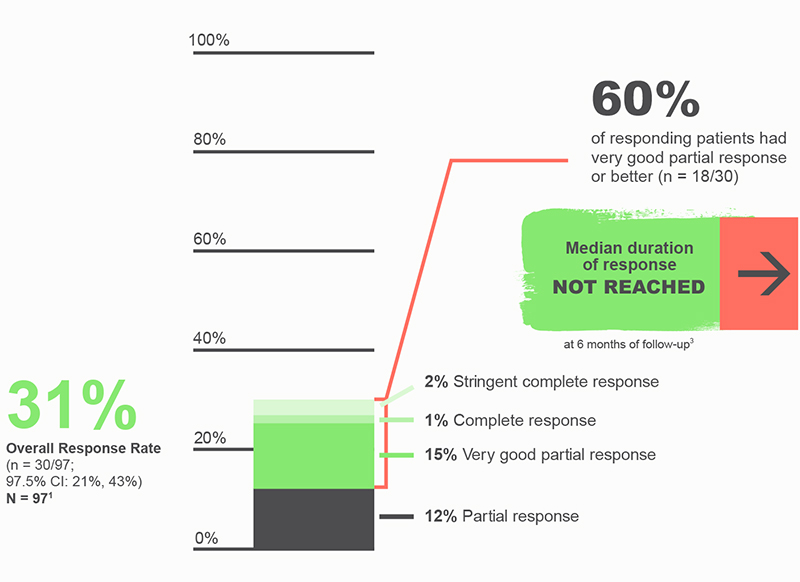
| Nearly
one-third of patients responded to
BLENREP1,3 |
| Clinically
meaningful and durable responses observed in a
patient population with a median 7 prior lines
of therapy | |
|
|
| • |
Overall
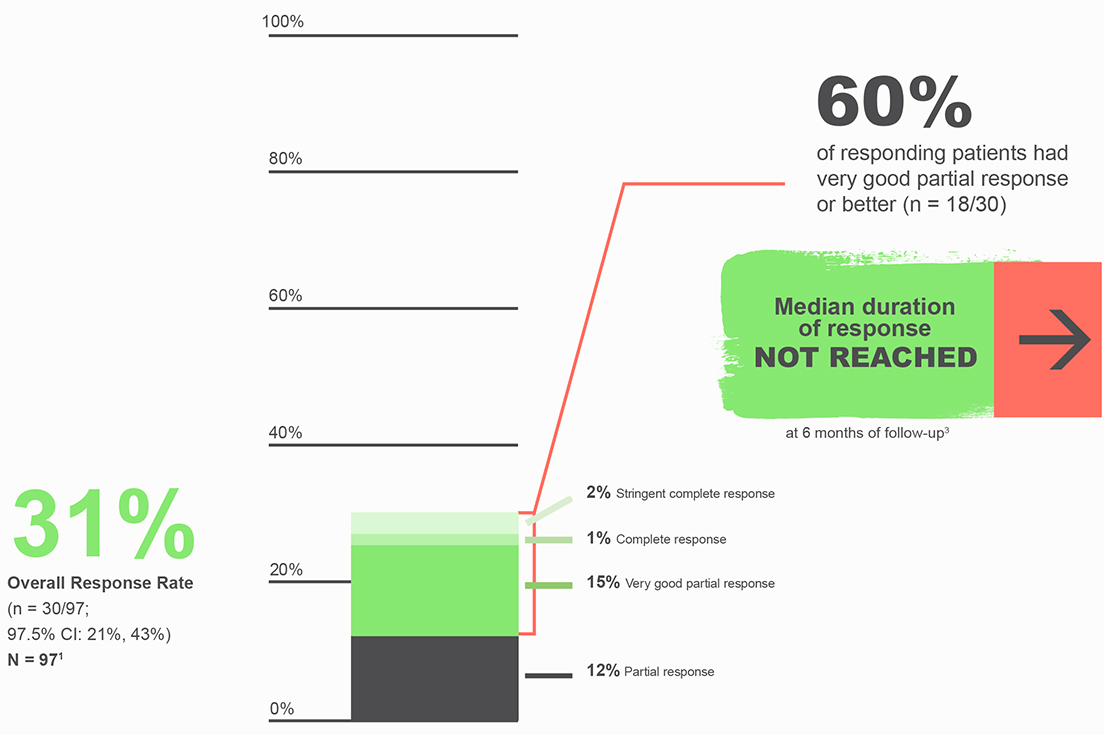
response rate with BLENREP was 31% (N =
30/97; 97.5% CI: 21%,
43%).1 | |
| • |
Median
time to first response was 1.4 months (95%
CI: 1.0,
1.6).1 | |
| • |
Clinically
meaningful response: the majority of
responders, 60% (18/30), achieved a very
good partial response or
better.1 | |
| • |
Durable
responses: 73% of responders had a duration
of response ≥6 months at the time of data
cutoff.1 | | | |
| |
|
|
| Study
design: DREAMM-2 was an open-label, phase 2
study of BLENREP with 2 parallel dosing cohorts of
patients with relapsed/refractory multiple myeloma
who had previously received 3 or more
anti-myeloma therapies, including an anti-CD38
monoclonal antibody, and were refractory to an
immunomodulatory agent and a proteasome inhibitor.
Patients were included if they had undergone
autologous stem cell transplant or were considered
transplant ineligible, and if they had measurable
disease by International Myeloma Working Group
(IMWG) criteria. Patients with renal impairment
and history of cytopenia (without active
conditions) were eligible. Patients received 2.5
mg/kg by intravenous infusion every 3 weeks until
disease progression, death, or unacceptable
toxicity. The efficacy outcome analysis is based
upon the results obtained with the recommended
dosage of 2.5 mg/kg (N = 97). Primary endpoint was
overall response rate, as evaluated by an
Independent Review Committee based on the IMWG
Uniform Response Criteria for Multiple Myeloma;
secondary endpoints included duration of
response and time to first response. The median
age of patients was 65 years (range: 39 to 85
years), 53% were male, 74% were White. The
majority of patients (77%) were International
Staging System Stage II or III at screening, 87%
had received prior autologous stem cell
transplantation, and 16% had an Eastern
Cooperative Oncology Group performance status of
2. High-risk cytogenetic factors (presence of
t[4;14], t[14;16], and
17p13del) were present in 27% of
patients. The median number of prior lines of
therapy was 7 (range: 3 to
21).1,3 | |
| |
| IMPORTANT
SAFETY INFORMATION
(CONT’D) |
| WARNINGS
AND PRECAUTIONS |
| Ocular
Toxicity: Ocular adverse reactions occurred in
77% of the 218 patients in the pooled safety
population. Ocular adverse reactions included
keratopathy (76%), changes in visual acuity
(55%), blurred vision (27%), and dry eye (19%).
Among patients with keratopathy (n = 165), 49%
had ocular symptoms, 65% had clinically relevant
visual acuity changes (decline of 2 or more lines
on Snellen Visual Acuity in any eye), and 34% had
both ocular symptoms and visual acuity changes.
|
| Keratopathy
: Keratopathy was reported as Grade 1 in 7%
of patients, Grade 2 in 22%, Grade 3 in 45%, and
Grade 4 in 0.5% per the KVA scale. Cases of
corneal ulcer (ulcerative and infective keratitis)
have been reported. Most keratopathy events
developed within the first 2 treatment cycles
(cumulative incidence of 65% by Cycle 2). Of the
patients with Grade 2 to 4 keratopathy (n =
149), 39% recovered to Grade 1 or lower after
median follow-up of 6.2 months. Of the 61% who
had ongoing keratopathy, 28% were still on
treatment, 9% were in follow-up, and in 24% the
follow-up ended due to death, study withdrawal, or
lost to follow-up. For patients in whom events
resolved, the median time to resolution was 2
months (range: 11 days to 8.3 months). |
| Visual
Acuity Changes : A clinically significant
decrease in visual acuity of worse than 20/40 in
the better-seeing eye was observed in 19% of the
218 patients and of 20/200 or worse in the
better-seeing eye in 1.4%. Of the patients with
decreased visual acuity of worse than 20/40,
88% resolved and the median time to resolution
was 22 days (range: 7 days to 4.2 months). Of
the patients with decreased visual acuity of
20/200 or worse, all resolved and the median
duration was 22 days (range: 15 to 22
days). |
| Monitoring
and Patient Instruction : Conduct ophthalmic
examinations (visual acuity and slit lamp) at
baseline, prior to each dose, and promptly for
worsening symptoms. Perform baseline examinations
within 3 weeks prior to the first dose. Perform
each follow-up examination at least 1 week after
the previous dose and within 2 weeks prior to the
next dose. Withhold BLENREP until improvement and
resume at same or reduced dose, or consider
permanently discontinuing based on severity.
Advise patients to use preservative-free lubricant
eye drops at least 4 times a day starting with the
first infusion and continuing until end of
treatment. Avoid use of contact lenses unless
directed by an ophthalmologist. Changes in visual
acuity may be associated with difficulty for
driving and reading. Advise patients to use
caution when driving or operating machinery.
BLENREP is only available through a restricted
program under a REMS. |
| Thrombocytopenia:
Thrombocytopenia occurred in 69% of 218
patients in the pooled safety population,
including Grade 2 in 13%, Grade 3 in 10%, and
Grade 4 in 17%. The median time to onset of the
first thrombocytopenic event was 26.5 days.
Thrombocytopenia resulted in dose reduction, dose
interruption, or discontinuation in 9%, 2.8%,
and 0.5% of patients, respectively. Grade 3 to 4
bleeding events occurred in 6% of patients,
including Grade 4 in 1 patient. Fatal adverse
reactions included cerebral hemorrhage in 2
patients. Perform complete blood cell counts at
baseline and during treatment as clinically
indicated. Consider withholding and/or reducing
the dose based on severity. |
| Infusion-Related
Reactions: Infusion-related reactions occurred
in 18% of 218 patients in the pooled safety
population, including Grade 3 in 1.8%. Monitor
patients for infusion-related reactions. For Grade
2 or 3 reactions, interrupt the infusion and
provide supportive treatment. Once symptoms
resolve, resume at a lower infusion rate.
Administer premedication for all subsequent
infusions. Discontinue BLENREP for
life-threatening infusion-related reactions and
provide appropriate emergency care. |
| Embryo-Fetal
Toxicity: Based on its mechanism of action,
BLENREP can cause fetal harm when administered to
a pregnant woman. Advise pregnant women of the
potential risk to a fetus. Advise females of
reproductive potential to use effective
contraception during treatment with BLENREP and
for 4 months after the last dose. Advise males
with female partners of reproductive potential to
use effective contraception during treatment with
BLENREP and for 6 months after the last dose.
Pregnancy testing is recommended for females of
reproductive potential prior to initiating
BLENREP. |
| ADVERSE
REACTIONS |
| The
pooled safety population described in Warnings
and Precautions reflects exposure to BLENREP
at a dosage of 2.5 mg/kg or 3.4
mg/kg (1.4 times the recommended dose)
administered intravenously once every 3 weeks in
218 patients in DREAMM-2. Of these patients,
194 received a liquid formulation (not the
approved dosage form) rather than the lyophilized
powder. |
| Patients
received BLENREP at the recommended dosage of 2.5
mg/kg administered intravenously once every
3 weeks (n = 95) . Permanent
discontinuation due to an adverse reaction
occurred in 8% of patients who received BLENREP;
keratopathy (2.1%) was the most frequent adverse
reaction resulting in permanent discontinuation.
Dosage interruptions due to an adverse reaction
occurred in 54% of patients who received BLENREP.
Adverse reactions which required a dosage
interruption in >3% of patients included
keratopathy (47%), blurred vision (5%), dry eye
(3.2%), and pneumonia (3.2%). Dose reductions
due to an adverse reaction occurred in 29% of
patients. Adverse reactions which required a dose
reduction in >3% of patients included
keratopathy (23%) and thrombocytopenia (5%).
|
| The
most common adverse reactions (≥20%) were
keratopathy (71%), decreased visual acuity (53%),
nausea (24%), blurred vision (22%), pyrexia (22%),
infusion-related reactions (21%), and fatigue
(20%). The most common Grade 3 or 4 (≥5%)
laboratory abnormalities were lymphocytes
decreased (22%), platelets decreased (21%),
hemoglobin decreased (18%), neutrophils decreased
(9%), creatinine increased (5%), and
gamma-glutamyl transferase increased (5%). |
| Serious
adverse reactions occurred in 40% of patients who
received BLENREP. Serious adverse reactions in
>3% of patients included pneumonia (7%),
pyrexia (6%), renal impairment (4.2%), sepsis
(4.2%), hypercalcemia (4.2%), and
infusion-related reactions (3.2%). Fatal adverse
reactions occurred in 3.2% of patients, including
sepsis (1%), cardiac arrest (1%), and lung
infection (1%). |
| USE
IN SPECIFIC POPULATIONS |
| Lactation:
Because of the potential for serious adverse
reactions in the breastfed child, advise women not
to breastfeed during treatment with BLENREP and
for 3 months after the last dose. |
| Females
and Males of Reproductive Potential: Based on
findings in animal studies, BLENREP may impair
fertility in females and males. |
| Geriatric
Use: Of the 218 patients who received
BLENREP in DREAMM-2, 43% were aged 65 to less
than 75 years and 17% were aged 75 years and
older. Keratopathy occurred in 80% of patients
aged less than 65 years and 73% of patients
aged 65 years and older. Among the 95 patients
who received BLENREP at the 2.5-mg/kg dose,
keratopathy occurred in 67% of patients aged less
than 65 years and 73% of patients aged 65
years and older. |
| Renal
or Hepatic Impairment: The recommended dosage
has not been established in patients with severe
renal impairment (eGFR 15 to 29 mL/min/1.73
m2) or end-stage renal disease (ESRD)
with eGFR <15 mL/min/1.73 m2 not
on dialysis or requiring dialysis. The recommended
dosage has not been established in patients with
moderate or severe hepatic impairment (total
bilirubin >1.5 × ULN and any AST). |
| Please
see full Prescribing
Information, including BOXED
WARNING. |
| References:
1. BLENREP Prescribing Information. 2.
Kumar SK, et al. Leukemia.
2017;31(11):2443-2448.
3. Lonial S, et al. Lancet Oncol.
2020;21(2):207-221. 4.
Data on file, GSK. | |
| |
| |
| This
email is intended for US healthcare
professionals only. |
| This
email is funded and developed by GSK.
|
| To
report SUSPECTED ADVERSE REACTIONS, contact GSK
at 1-888-825-5249 or FDA at
1-800-FDA-1088 or www.fda.gov/medwatch.
|
| Trademarks
are property of their respective owners.
|
|
|
©2021
GSK or licensor.
BLMEML210002
March 2021
Produced in USA.
| | |
| GSK,
5 Crescent Drive, Philadelphia, PA
19112
| |
| | |
| | | |
|
|
| |