Mirvetuximab soravtansine-gynx (ELAHERE®) is recommended by the National Comprehensive Cancer Network® (NCCN®) as the only Category 1, Preferred option for FRα-positive (≥75% positive tumor cells), platinum-resistant ovarian cancer1,2
The majority of patients with ovarian cancer who receive platinum-based treatment eventually become platinum resistant (PFI ≤6 months). ELAHERE is for patients with FRα-positive* PROC.3-5
*FRα positive is defined as ≥75% of viable tumor cells with moderate (2+) and/or strong (3+) membrane staining based on an IHC assay.2
ELAHERE is indicated for the treatment of adult patients with folate receptor-alpha (FRα) positive, platinum-resistant epithelial ovarian, fallopian tube, or primary peritoneal cancer, who have received one to three prior systemic treatment regimens. Select patients for therapy based on an FDA-approved test.
IMPORTANT SAFETY INFORMATION
WARNING: OCULAR TOXICITY
ELAHERE can cause severe ocular toxicities, including visual impairment, keratopathy, dry eye, photophobia, eye pain, and uveitis.
Conduct an ophthalmic exam including visual acuity and slit lamp exam prior to initiation of ELAHERE, every other cycle for the first 8 cycles, and as clinically indicated.
Administer prophylactic artificial tears and ophthalmic topical steroids.
Withhold ELAHERE for ocular toxicities until improvement and resume at the same or reduced dose.
Discontinue ELAHERE for Grade 4 ocular toxicities.
ELAHERE was studied in MIRASOL—the first and only positive Phase 3 study specifically for this population. In the study, ELAHERE (n=227) demonstrated superior results in PFS (primary endpoint) and OS and ORR (key secondary endpoints) vs standard single-agent chemotherapy (n=226; paclitaxel, pegylated liposomal doxorubicin, and topotecan).5-8
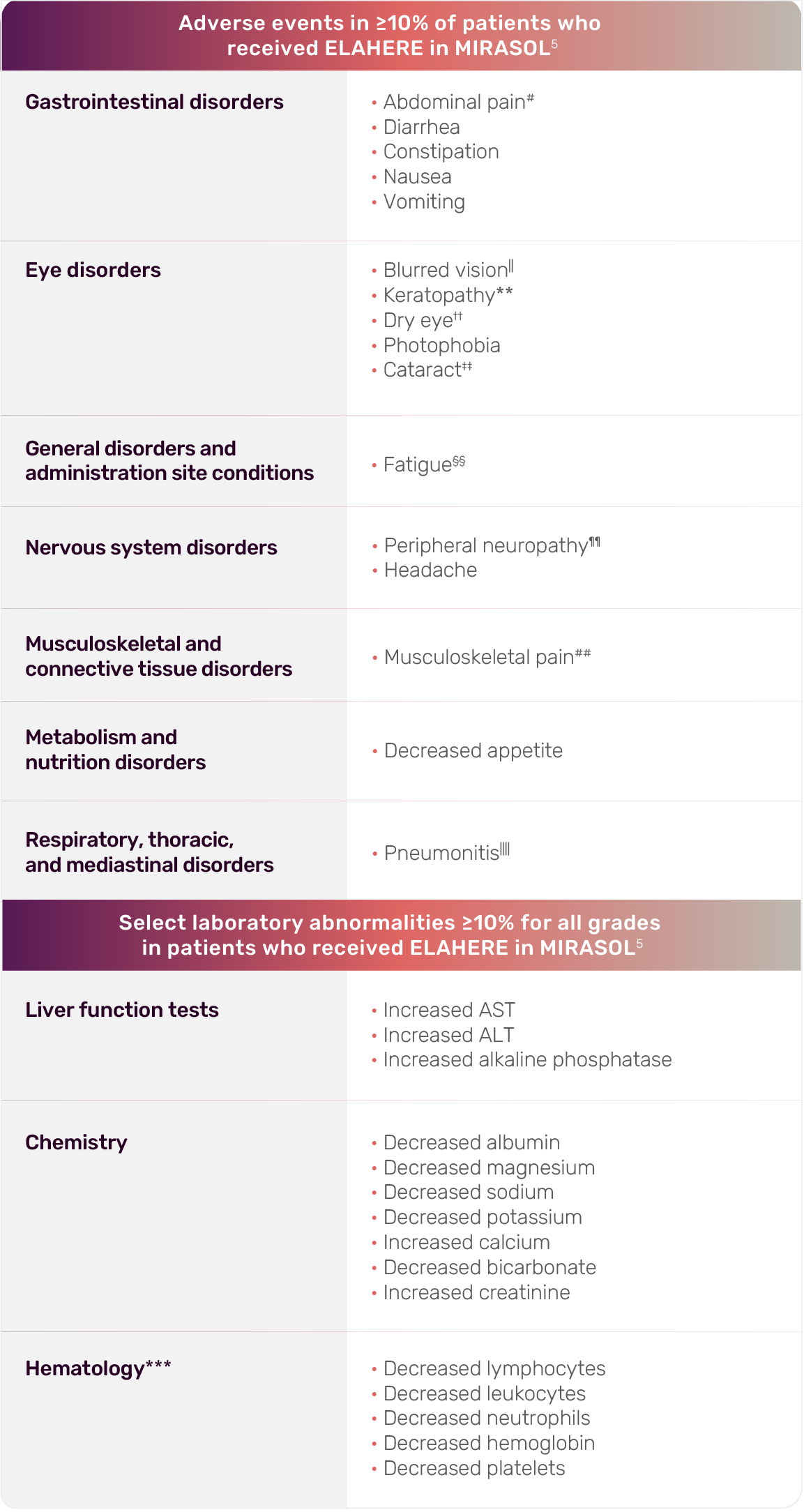
AN OVERVIEW OF SAFETY TO HELP SUPPORT YOUR PATIENTS THROUGH TREATMENT5
#Abdominal pain includes abdominal pain, abdominal pain upper, abdominal pain lower, and abdominal discomfort.5
||Blurred vision includes vision blurred, vitreous floaters, visual acuity reduced, diplopia, accommodation disorder, and visual impairment.5
**Keratopathy includes corneal disorder, corneal epithelial microcysts, keratitis, keratopathy, corneal deposits, punctate keratitis, and corneal opacity.5
††Dry eye includes dry eye and lacrimation increased.5
‡‡Cataract includes cataract and cataract nuclear.5
§§Fatigue includes fatigue and asthenia.5
¶¶Peripheral neuropathy includes neuropathy peripheral, peripheral sensory neuropathy, peripheral motor neuropathy, paresthesia, hypoesthesia, polyneuropathy, neurotoxicity, and peripheral sensorimotor neuropathy.5
##Musculoskeletal pain includes back pain, myalgia, neck pain, arthralgia, musculoskeletal pain, noncardiac chest pain, bone pain, pain in extremity, musculoskeletal stiffness, musculoskeletal chest pain, and musculoskeletal discomfort.5
||||Pneumonitis includes pneumonitis, interstitial lung disease, respiratory failure, and organizing pneumonia.5
***The denominator used to calculate the rate varied from 63 to 214 (ELAHERE) and from 63 to 194 (IC chemotherapy) based on the number of patients with a baseline value and at least 1 posttreatment value.5
Ocular events seen and managed across clinical trials6†††
Ocular events were mostly Grade 1 or 2. 59% of patients treated with ELAHERE had an ocular event; 11% of patients experienced Grade 3 ocular events5,6
Ocular events completely or partially resolved for most patients. Of the patients treated with ELAHERE who had an ocular event, 53% had complete resolution and 38% had partial improvement5‡‡‡
1% of patients discontinued ELAHERE due to ocular events5
Median time to onset of the first ocular event was 5.1 weeks (range: 0.1 to 68.6)5
This pooled safety population reflects exposure to ELAHERE in 682 patients with epithelial ovarian, fallopian tube, or primary peritoneal cancer at 6 mg/kg AIBW administered intravenously once every 3 weeks until disease progression or unacceptable toxicity in 4 clinical trials: MIRASOL, SORAYA, NCT02631876, and NCT01609556. The median duration of treatment was 4.4 months (range: 1.0 to 30.0). The most common (≥5%) ocular adverse reactions were blurred vision (48%), keratopathy (36%), dry eye (27%), cataract (16%), photophobia (14%), and eye pain (10%).5
†††In Study 0416, Study 0417, Study 0403 (NCT02631876), and Study 0401 (NCT01609556).5
‡‡‡Partial improvement was defined as improvement by ≥1 grade from the worst grade at last follow-up.6
AIBW=adjusted ideal body weight; ALT=alanine aminotransferase; AST=aspartate aminotransferase; IC=investigator's choice.
ELAHERE can cause severe ocular adverse reactions, including visual impairment, keratopathy (corneal disorders), dry eye, photophobia, eye pain, and uveitis.
Ocular adverse reactions occurred in 59% of patients with ovarian cancer treated with ELAHERE. Eleven percent (11%) of patients experienced Grade 3 ocular adverse reactions, including blurred vision, keratopathy (corneal disorders), dry eye, cataract, photophobia, and eye pain; two patients (0.3%) experienced Grade 4 events (keratopathy and cataract). The most common (≥5%) ocular adverse reactions were blurred vision (48%), keratopathy (36%), dry eye (27%), cataract (16%), photophobia (14%), and eye pain (10%).
The median time to onset for first ocular adverse reaction was 5.1 weeks (range: 0.1 to 68.6). Of the patients who experienced ocular events, 53% had complete resolution; 38% had partial improvement (defined as a decrease in severity by one or more grades from the worst grade at last follow up). Ocular adverse reactions led to permanent discontinuation of ELAHERE in 1% of patients.
Premedication and use of lubricating and ophthalmic topical steroid eye drops during treatment with ELAHERE are recommended. Advise patients to avoid use of contact lenses during treatment with ELAHERE unless directed by a healthcare provider.
Refer patients to an eye care professional for an ophthalmic exam including visual acuity and slit lamp exam prior to treatment initiation, every other cycle for the first 8 cycles, and as clinically indicated. Promptly refer patients to an eye care professional for any new or worsening ocular signs and symptoms.
Monitor for ocular toxicity and withhold, reduce, or permanently discontinue ELAHERE based on severity and persistence of ocular adverse reactions.
Pneumonitis
Severe, life-threatening, or fatal interstitial lung disease (ILD), including pneumonitis, can occur in patients treated with ELAHERE.
Pneumonitis occurred in 10% of patients treated with ELAHERE, including 1% with Grade 3 events and 1 patient (0.1%) with a Grade 4 event. One patient (0.1%) died due to respiratory failure in the setting of pneumonitis and lung metastases. One patient (0.1%) died due to respiratory failure of unknown etiology. Pneumonitis led to permanent discontinuation of ELAHERE in 3% of patients.
Monitor patients for pulmonary signs and symptoms of pneumonitis, which may include hypoxia, cough, dyspnea, or interstitial infiltrates on radiologic exams. Infectious, neoplastic, and other causes for such symptoms should be excluded through appropriate investigations. Withhold ELAHERE for patients who develop persistent or recurrent Grade 2 pneumonitis until symptoms resolve to ≤ Grade 1 and consider dose reduction. Permanently discontinue ELAHERE in all patients with Grade 3 or 4 pneumonitis. Patients who are asymptomatic may continue dosing of ELAHERE with close monitoring.
Peripheral Neuropathy (PN)
Peripheral neuropathy occurred in 36% of patients with ovarian cancer treated with ELAHERE across clinical trials; 3% of patients experienced Grade 3 peripheral neuropathy. Peripheral neuropathy adverse reactions included peripheral neuropathy (20%), peripheral sensory neuropathy (9%), paraesthesia (6%), neurotoxicity (3%), hypoaesthesia (1%), peripheral motor neuropathy (0.9%), polyneuropathy (0.3%), and peripheral sensorimotor neuropathy (0.1%). Monitor patients for signs and symptoms of neuropathy, such as paresthesia, tingling or a burning sensation, neuropathic pain, muscle weakness, or dysesthesia. For patients experiencing new or worsening PN, withhold dosage, dose reduce, or permanently discontinue ELAHERE based on the severity of PN.
Embryo-Fetal Toxicity
Based on its mechanism of action, ELAHERE can cause embryo-fetal harm when administered to a pregnant woman because it contains a genotoxic compound (DM4) and affects actively dividing cells.
Advise pregnant women of the potential risk to a fetus. Advise females of reproductive potential to use effective contraception during treatment with ELAHERE and for 7 months after the last dose.
ADVERSE REACTIONS
The most common (≥20 %) adverse reactions, including lab abnormalities, were increased aspartate aminotransferase, fatigue, increased alanine aminotransferase, blurred vision, nausea, increased alkaline phosphatase, diarrhea, abdominal pain, keratopathy, peripheral neuropathy, musculoskeletal pain, decreased lymphocytes, decreased platelets, decreased magnesium, decreased hemoglobin, dry eye, constipation, decreased leukocytes, vomiting, decreased albumin, decreased appetite, and decreased neutrophils.
DRUG INTERACTIONS
DM4 is a CYP3A4 substrate. Closely monitor patients for adverse reactions with ELAHERE when used concomitantly with strong CYP3A4 inhibitors.
USE IN SPECIAL POPULATIONS
Lactation
Advise women not to breastfeed during treatment with ELAHERE and for 1 month after the last dose.
Hepatic Impairment
Avoid use of ELAHERE in patients with moderate or severe hepatic impairment (total bilirubin >1.5 ULN).
This content is sponsored by AbbVie, and ION Oncology Practice Network has not independently reviewed or verified the information provided by AbbVie.
This email was sent to karleigh.bard-marsh@cencora.com because you have an account with or are a valued partner of Cencora Specialty GPOs | ION Oncology Practice Network. If you no longer wish to receive these types of emails, please click here to unsubscribe or update your email preferences.