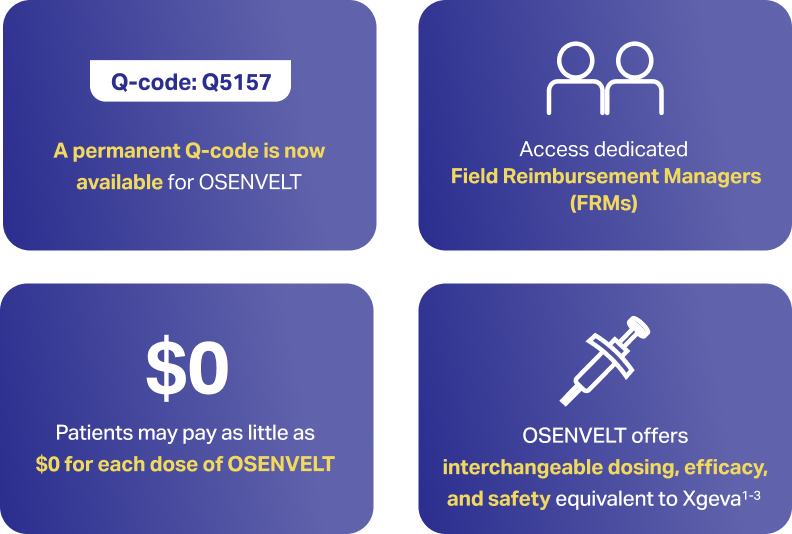
OSENVELT—a proven interchangeable biosimilar to Xgeva® (denosumab)—is now available with a Q-code1
Streamline reimbursement with a high‑quality, low‑cost interchangeable for Xgeva
A permanent Q-code has been assigned to OSENVELT
Code
NDC
Product
Dose
Units
Q5157
72606-038-01
OSENVELT
120mg/1.7mL
1 vial
Celltrion provides dedicated FRMs who may be able to support your office.
Call the Celltrion CONNECT® Patient Support Program to find out more: 1‑877‑81CONNC (1‑877‑812‑6662).
Patients may pay as little as $0 for each dose of OSENVELT when enrolled in Celltrion CARES®*
* All patients enrolled in the Celltrion CONNECT® Patient Support Program are automatically screened for financial assistance. Program calendar maximums apply. Please see full
Terms and Conditions.
OSENVELT provides your practice with an interchangeable alternative to Xgeva, indicated for the2:
Prevention of skeletal-related events in patients with multiple myeloma and in patients with bone metastases from solid tumors
Treatment of adults and skeletally mature adolescents with giant cell tumor of bone that is unresectable or where surgical resection is likely to result in severe morbidity
Treatment of hypercalcemia of malignancy refractory to bisphosphonate therapy
Contraindications: Patients with hypocalcemia or with known clinically significant hypersensitivity to denosumab products.
Drug Products with Same Active Ingredient. Patients receiving OSENVELT should not receive other denosumab products concomitantly.
Hypersensitivity. Clinically significant hypersensitivity including anaphylaxis has been reported with denosumab products. If an anaphylactic or other clinically significant allergic reaction occurs, initiate appropriate therapy and discontinue further use of OSENVELT.
Hypocalcemia. Severe hypocalcemia can occur, and fatal cases have been reported. Monitor calcium levels and calcium and vitamin D intake.
Osteonecrosis of the Jaw (ONJ).
ONJ can occur in patients on OSENVELT. A routine oral exam and appropriate preventive dentistry are recommended before starting and during treatment with OSENVELT. Good oral hygiene should be maintained. Avoid invasive dental procedures during treatment with OSENVELT. For invasive dental procedures, consider temporary discontinuation of OSENVELT. If ONJ develops, consult a dentist or oral surgeon. Extensive surgery may worsen ONJ, consider discontinuing OSENVELT based on a benefit-risk assessment.
Atypical Subtrochanteric and Diaphyseal Femoral Fracture. Atypical femoral fracture has been reported with denosumab products. During OSENVELT treatment, patients should be advised to report new or unusual thigh, hip, or groin pain. Patients with thigh or groin pain should be evaluated for an atypical femur fracture, including assessment for potential fractures in the contralateral limb. Interruption of OSENVELT therapy should be considered, pending a benefit-risk assessment, on an individual basis.
Hypercalcemia Following Treatment Discontinuation in Patients with Giant Cell Tumor of Bone and in Patients with Growing Skeletons.
Clinically significant hypercalcemia, sometimes requiring hospitalization and complicated by acute renal injury, has occurred in denosumab-treated patients with giant cell tumor of bone and in those with growing skeletons, often within the first year after discontinuation. After treatment discontinuation, monitor for hypercalcemia symptoms, check serum calcium periodically, reassess calcium and vitamin D needs, and manage as appropriate.
Multiple Vertebral Fractures (MVF) Following Treatment Discontinuation. Following discontinuation of denosumab treatment, fracture risk increases, including the risk of multiple vertebral fractures. Evaluate the individual patient's risk for vertebral fractures after OSENVELT discontinuation.
Embryo-Fetal Toxicity. Denosumab may cause fetal harm based on animal studies and its mechanism of action. Verify pregnancy status in females of reproductive potential before starting OSENVELT and advise them to use effective contraception during treatment and for 5 months after the last dose to prevent fetal harm.
Adverse Reactions:
Bone Metastasis from Solid Tumors: Most common adverse reactions (≥ 25%) were fatigue/asthenia, hypophosphatemia, and nausea.
Multiple Myeloma: Most common adverse reactions (≥ 10%) were diarrhea, nausea, anemia, back pain, thrombocytopenia, peripheral edema, hypocalcemia, upper respiratory tract infection, rash, and headache.
Giant Cell Tumor of Bone: Most common adverse reactions (≥ 10%) were arthralgia, headache, nausea, back pain, fatigue, and pain in extremity.
Hypercalcemia of Malignancy: Most common adverse reactions (> 20%) were nausea, dyspnea, decreased appetite, headache, peripheral edema, vomiting, anemia, constipation, and diarrhea.
References:1. Reginster J-Y, Czerwinski E, Wilk K, et al. Efficacy and safety of candidate biosimilar CT-P41 versus reference denosumab: a double-blind, randomized, active controlled, phase 3 trial in postmenopausal women with osteoporosis. Osteoporos Int. 2024;35(11):1919-1930. doi: 10.1007/s00198-024-07161-x 2. OSENVELT Prescribing Information. Celltrion USA, Inc; 2024.
3. Xgeva Prescribing Information. Amgen, Inc; 2020.
Xgeva® is a registered trademark of Amgen, Inc. OSENVELT® is a registered trademark of Celltrion, Inc., used under license. Celltrion CARES is a registered trademark of Celltrion, Inc., used under license. Celltrion CONNECT is a registered trademark of Celltrion Holdings Co., Ltd., used under license.
This content is sponsored by Celltrion, and ION Oncology Practice Network has not independently reviewed or verified the information provided by Celltrion.
This email was sent to meghan.jacobson@amerisourcebergen.com because you have an account with or are a valued partner of Cencora Specialty GPOs | ION Oncology Practice Network. If you no longer wish to receive these types of emails, please
click here to unsubscribe or update your email preferences.