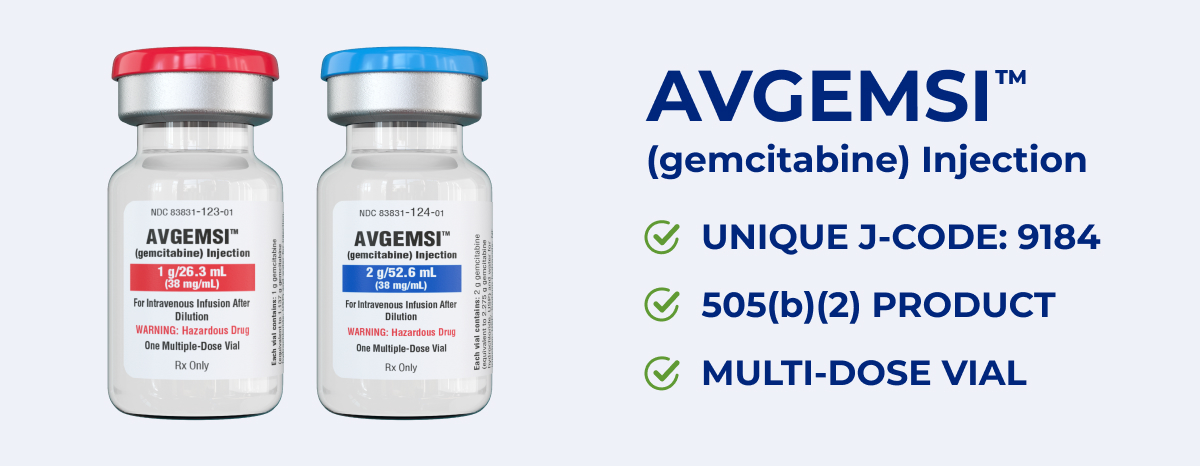
NEW UNIQUE J-CODE J9184
EFFECTIVE JANUARY 1, 2026 |
|
|
|
|
INDICATIONS AND IMPORTANT SAFETY INFORMATION
|
|
|
|
|
AVGEMSI™ in combination with carboplatin is indicated for the treatment of patients with advanced ovarian cancer that has relapsed at least 6 months after completion of platinum-based therapy. |
|
AVGEMSI in combination with paclitaxel is indicated for the first-line treatment of patients with metastatic breast cancer after failure of prior anthracycline-containing adjuvant chemotherapy, unless anthracyclines were clinically contraindicated. |
|
Non-Small Cell Lung Cancer |
|
AVGEMSI in combination with cisplatin is indicated for the first-line treatment of patients with inoperable, locally advanced (Stage IIIA or IIIB) or metastatic (Stage IV) non-small cell lung cancer (NSCLC). |
|
AVGEMSI is indicated as first-line treatment for patients with locally advanced (nonresectable Stage II or Stage III) or metastatic (Stage IV) adenocarcinoma of the pancreas. AVGEMSI is indicated for patients previously treated with fluorouracil. |
|
IMPORTANT SAFETY INFORMATION |
|
AVGEMSI is contraindicated in patients with a known hypersensitivity to gemcitabine. Reactions include anaphylaxis. |
|
Schedule-Dependent Toxicity: In clinical trials evaluating the maximum tolerated dose of gemcitabine, prolongation of the infusion time beyond 60 minutes or more frequent than weekly dosing resulted in an increased incidence of clinically significant hypotension, severe flu-like symptoms, myelosuppression, and asthenia. The half-life of gemcitabine is influenced by the length of the infusion. |
|
Myelosuppression:
Myelosuppression manifested by neutropenia, thrombocytopenia, and anemia, occurs with gemcitabine as a single agent and the risks are increased when gemcitabine is combined with other cytotoxic drugs. In clinical trials, Grade 3-4 neutropenia, anemia, and thrombocytopenia occurred in 25%, 8%, and 5%, respectively of the 979 patients who received single agent gemcitabine. The frequencies of Grade 3-4 neutropenia, anemia, and thrombocytopenia varied from 48% to 71%, 8% to 28%, and 5% to 55%, respectively, in patients receiving gemcitabine in combination with another drug. |
|
Prior to each dose of AVGEMSI, obtain a complete blood count (CBC) with a differential and a platelet count. Modify the dosage as recommended. |
|
Severe Cutaneous Adverse Reactions (SCARs): SCARs, including Stevens-Johnson syndrome (SJS), toxic epidermal necrolysis (TEN), drug reaction with eosinophilia and systemic symptoms (DRESS), and acute generalized exanthematous pustulosis (AGEP), which can be life-threatening or fatal, have been reported in association with gemcitabine treatment. Monitor patients for signs and symptoms of severe cutaneous adverse reactions. Permanently discontinue gemcitabine in patients who develop SCARs. |
|
Pulmonary Toxicity and Respiratory Failure: Pulmonary toxicity, including interstitial pneumonitis, pulmonary fibrosis, pulmonary edema, and adult respiratory distress syndrome (ARDS), has been reported. In some cases, these pulmonary events can lead to fatal respiratory failure despite the discontinuation of therapy. The onset of pulmonary symptoms may occur up to 2 weeks after the last dose of gemcitabine. |
|
Permanently discontinue AVGEMSI in patients who develop unexplained dyspnea, with or without bronchospasm, or evidence of severe pulmonary toxicity. |
|
Hemolytic Uremic Syndrome (HUS): HUS, including fatalities from renal failure or the requirement for dialysis, can occur with gemcitabine. In clinical trials, HUS occurred in 0.25% of 2429 patients. Most fatal cases of renal failure were due to HUS. Serious cases of thrombotic microangiopathy other than HUS have been reported with gemcitabine. |
|
Assess renal function prior to initiation of AVGEMSI and periodically during treatment. Consider the diagnosis of HUS in patients who develop anemia with evidence of microangiopathic hemolysis; increased bilirubin or LDH; reticulocytosis; severe thrombocytopenia; or evidence of renal failure (increased serum creatinine or BUN). Permanently discontinue AVGEMSI in patients with HUS or severe renal impairment. Renal failure may not be reversible even with the discontinuation of therapy. |
|
Hepatic Toxicity:
Drug-induced liver injury, including liver failure and death, has been reported in patients receiving gemcitabine alone or with other potentially hepatotoxic drugs. Administration of gemcitabine in patients with concurrent liver metastases or a pre-existing medical history of hepatitis, alcoholism, or liver cirrhosis can lead to exacerbation of the underlying hepatic insufficiency. Assess hepatic function prior to initiation of AVGEMSI and periodically during treatment. Permanently discontinue AVGEMSI in patients who develop severe hepatic toxicity. |
|
Embryo-Fetal Toxicity: AVGEMSI can cause fetal harm when administered to a pregnant woman. Advise pregnant women of the potential risk to a fetus. Advise females of reproductive potential to use effective contraception during treatment with AVGEMSI and for 6 months after the final dose. Advise male patients with female partners of reproductive potential to use effective contraception during treatment with AVGEMSI and for 3 months following the final dose. |
|
Exacerbation of Radiation Therapy Toxicity: Gemcitabine is not recommended for use in combination with radiation therapy. |
|
Concurrent (given together or ≤7 days apart)
Life-threatening mucositis, especially esophagitis and pneumonitis occurred in a trial in which gemcitabine was administered at a dose of 1000 mg/m2 to patients with non-small cell lung cancer for up to 6 consecutive weeks concurrently with thoracic radiation. |
|
Non-concurrent (given >7 days apart)
Excessive toxicity has not been observed when gemcitabine is administered more than 7 days before or after radiation. Radiation recall has been reported in patients who received gemcitabine after prior radiation. |
|
Capillary Leak Syndrome (CLS): CLS with severe consequences has been reported in patients receiving gemcitabine as a single agent or in combination with other chemotherapeutic agents. Permanently discontinue AVGEMSI if CLS develops during therapy. |
|
Posterior Reversible Encephalopathy Syndrome (PRES): PRES has been reported in patients receiving gemcitabine as a single agent or in combination with other chemotherapeutic agents. PRES can present with headache, seizure, lethargy, hypertension, confusion, blindness, and other visual and neurologic disturbances. Confirm the diagnosis of PRES with magnetic resonance imaging (MRI). Permanently discontinue AVGEMSI if PRES develops during therapy. |
|
The most common adverse reactions for the single agent (≥20%) are nausea/vomiting, anemia, increased aspartate aminotransferase (AST), increased alanine aminotransferase (ALT), neutropenia, increased alkaline phosphatase, proteinuria, fever, hematuria, rash, thrombocytopenia, dyspnea, and edema. |
|
USE IN SPECIFIC POPULATIONS |
|
Pregnancy: Advise pregnant women of the potential risk to a fetus with AVGEMSI. |
|
Lactation: Advise women not to breastfeed during treatment with AVGEMSI. |
|
Females and Males of Reproductive Potential: Advise females and males of reproductive potential to use effective contraception during treatment with AVGEMSI. |
|
|
|
|
There is no known antidote for overdoses of gemcitabine. Myelosuppression, paresthesias, and severe rash were the principal toxicities seen when a single dose as high as 5700 mg/m2 was administered by intravenous infusion over 30 minutes every 2 weeks to several patients in a dose-escalation study. In the event of suspected overdose, monitor with appropriate blood counts and provide supportive therapy, as necessary. |
|
To report SUSPECTED ADVERSE REACTIONS, contact Avyxa Pharma, LLC at 1-888-520-0954 or FDA at 1-800-FDA-1088 or www.fda.gov/medwatch |
|
|
|
|
All trademarks are registered property of their respective owners. |
|
©2025 Avyxa Pharma, LLC. All rights reserved. US-AVG-0011-1 |
|
|
|
|
|